 Instragram






Biography
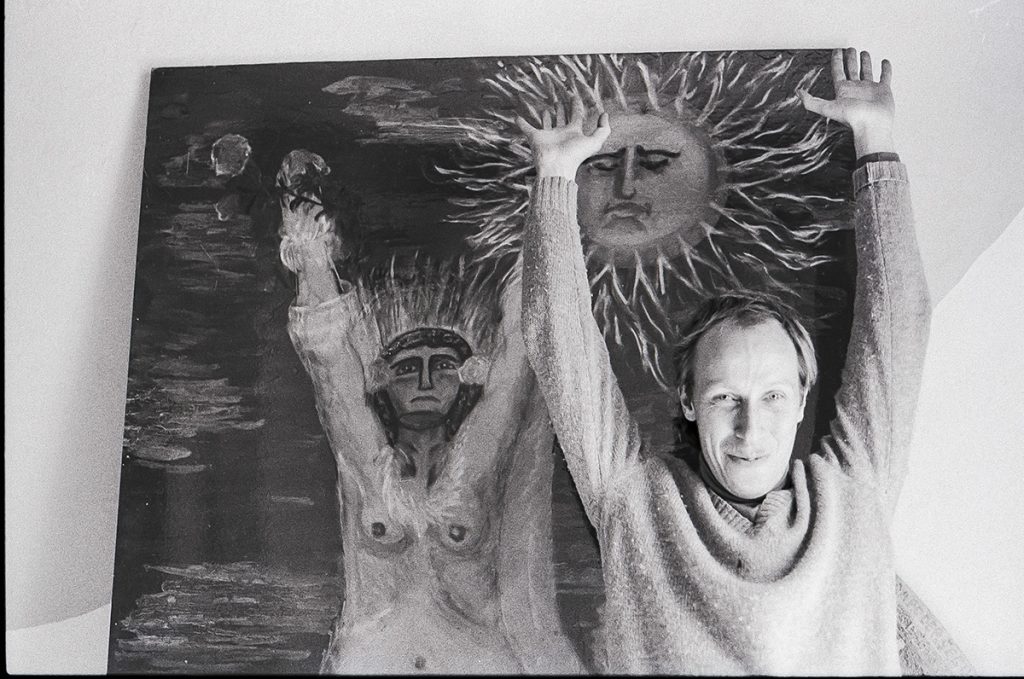
The painting of Santiago García Sáenz (Buenos Aires, 1955–2006) cultivated from the outset a sensibility capable of blending the world of everyday life — with its particular strain of costumbrismo — and the fantasy of ecstatic states, constructing a figurative plastic language that oscillates between the real and the iconic without interruption. The impact of his Catholic faith gave his work a very particular ethics of the image: the presence of sacred genres and biblical scenes in his painting introduces the problem of the punished body and light as a redemptive force. His painting presents itself as a way of recovering an iconography of memory, but also of staging the experience of the body itself. This serves not only to reproduce scenes of travel, landscapes, or figures from Latin American indigenous traditions, but also to allow sacred images to be inflected by the baroque logic of memory, dream, and ecstasy. This poetics also led him to experiment with means beyond conventional painting, including public murals, the making of costumes, and performances such as banner processions and the installation of painted volumes (tondos, folding screens, sculptures, altarpieces, nativity scenes).
In his series Te estoy buscando América, he superimposes miniature religious scenes onto a folklore halfway between the real and the imaginary, shaped by his successive travels across Latin America (Brazil, Bolivia, Mexico, Ecuador, and above all Paraguay — its jungle geography, its Jesuit legacy, and its version of American baroque). In parallel, he developed a sensibility closely attuned to contemporary events (the Falklands War, the bombing of the AMIA headquarters in Buenos Aires, among others). The series of martyr figures and wounded bodies, conceived simultaneously, complete this response to the fin-de-siècle moment in which HIV/AIDS and social crisis emerge as two constitutive dimensions of his present. Toward the end of his career, García Sáenz’s painting gained increasing assurance and embarked on a new vital cycle in which many of the elements of his trajectory converge and synthesize. On one hand, he began working with the painter’s self-portrait and childhood portraits, among other autobiographical genres, in which he always appears surrounded by images. On the other, he produced an extensive series of baroque paintings in which Jesuit ruins, lush green landscapes, vertical urban settings, sacred architectures, and small beatific figures coexist.
His work has been exhibited in numerous institutions inside and outside Argentina, including the Museo Nacional de Bellas Artes, MALBA – Museo de Arte Latinoamericano de Buenos Aires, the Museo de Arte Moderno de Buenos Aires, the Museo de Arte Hispanoamericano Isaac Fernández Blanco, the Centro Cultural Recoleta, the Museo de Bellas Artes de Salta, the Centro Cultural Ricardo Rojas, and the Museo del Barro, among others. In 2021, the Amalia Lacroze de Fortabat Art Collection presented Quiero ser luz y quedarme, an anthological exhibition curated by Pablo León de la Barra and Santiago Villanueva, accompanied by a catalogue with works and essays.
His work is held in institutional collections including the Guggenheim Museum (New York), the Centre Pompidou (Paris), the Vatican Museums (Vatican City), the Museo del Barro (Asunción), the Museo Nacional de Bellas Artes (Buenos Aires), MALBA (Buenos Aires), the Museo de Arte Moderno de Buenos Aires, the Colección Federico Jorge Klemm (Buenos Aires), the Colección AMALITA. Colección de Arte Amalia Lacroze de Fortabat (Buenos Aires), the Museo Provincial de Bellas Artes Dr. Juan R. Vidal (Corrientes), the Museo Casa Arias Rengel (Salta), and private collections in Argentina, the United States, Paraguay, and Brazil, among others.